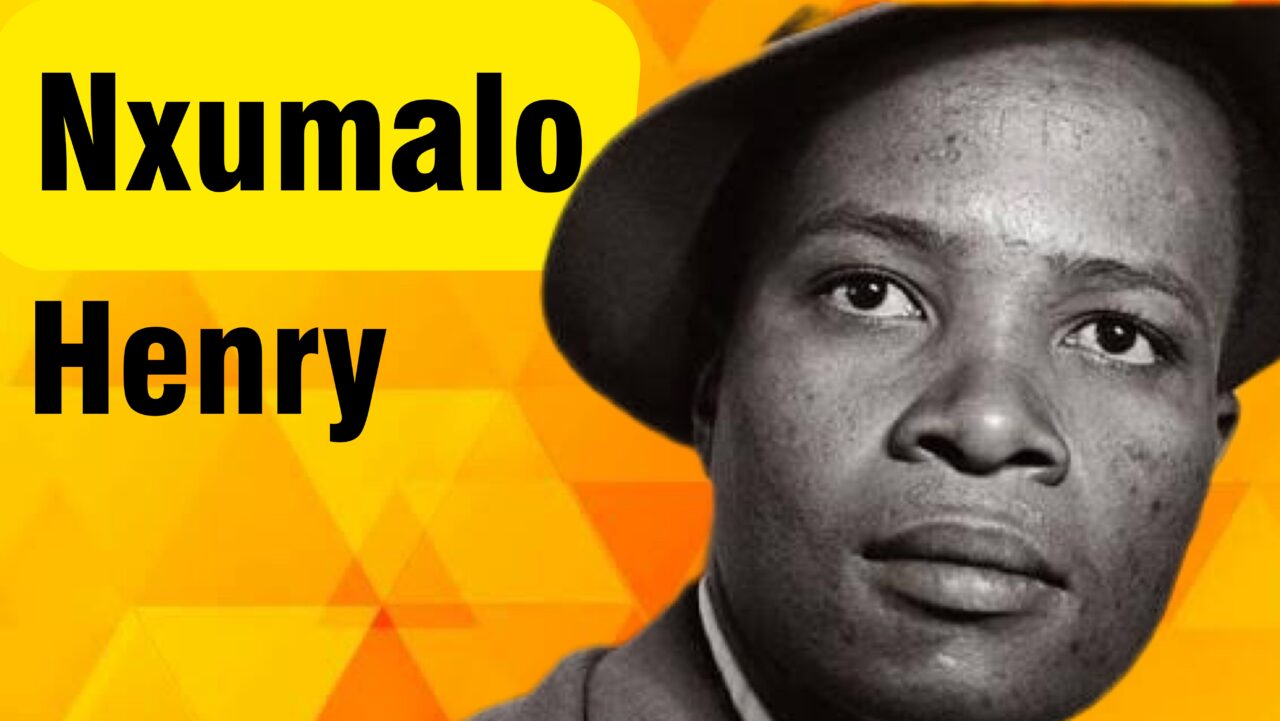
He was born in 1917 in Margate, Natal, South Africa, and attended the Fascadale Mission School. Showing early promise as a writer, he submitted various samples of his work to publications and as a result was offered a job by the Post newspaper in Johannesburg, which had published some of his earlier contributions.
He enlisted in the South African Army when World War II broke out and was sent to Egypt, where the South African forces were involved in the Western Desert of North Africa.
He became frustrated upon his return to South Africa. There were few opportunities for black journalists due to the restrictions of apartheid. Most black-focused publications were controlled by white business interests and none of them offered scope for the kind of investigative exposés that Nxumalo had in mind.
In 1951, the publisher Jim Bailey established the legendary Drum magazine with Anthony Sampson as editor, and asked Henry Nxumalo to become the assistant editor. Nxumalo by this time specialised in investigative journalism.
He obtained employment on the potato farms so as to expose the squalid conditions (almost slave-like) experienced by Black labourers. Worried about the lawlessness in Johannesburg “the square mile of sin”, he agitated for clean-up and appealed for support from the police.
On another assignment he managed to get himself arrested and was sent to Johannesburg central prison. His resulting article, describing the ward conditions and the degrading naked search, was an international scoop. He later got work on a farm where an African labourer was beaten to death with a section of hose-pipe. His investigation into whether the church “supported” apartheid showed the difference between prejudice and the gospel of “brotherly love”.
In 1957, Nxumalo was investigating an abortion racket when he was murdered by unknown assailants.
They established a powerful kingdom between the Pongola River and the Black Umfolozi River during the eighteenth century. Under the leadership of their king Yaka, they dominated the region. Today, they can be found in South Africa, Eswatini, and Zimbabwe. 1758-1825)The most renowned king of the Ndwandwe, ruling from about 1805 to 1820 from his capital on Magudu Mountain south of present-day Pongola. Around 1818, his armies destroyed the Mthethwa under King Dingiswayo at Mbuzi Hill, leaving Zwide as the most powerful leader in the region. In 1819, he launched a second expedition against Shaka’s Zulu, but his forces were decisively defeated at the Battle of Mhlatuze River in 1820, leading to the fragmentation of the Ndwandwe nation. His generals and sons, including Soshangane and Zwangendaba, led segments of the Ndwandwe northwards, establishing the Gaza Empire in Mozambique and the Ngoni peoples in Malawi, Zambia, and Tanzania. The remaining majority were absorbed into the Zulu Kingdom. His research focuses on the histories of chiefdoms and the British strategy to dismantle the senior branch of the Zulu royal family (Usuthu) from 1880 to 1913. His work examines the intersection of social structures, power dynamics, and historical narratives, contributing to a deeper understanding of South Africa’s royal past. 🔍 Search here 🔍+ ADD CLAN NAMES🎬 Watch our videos
Leave a Reply